
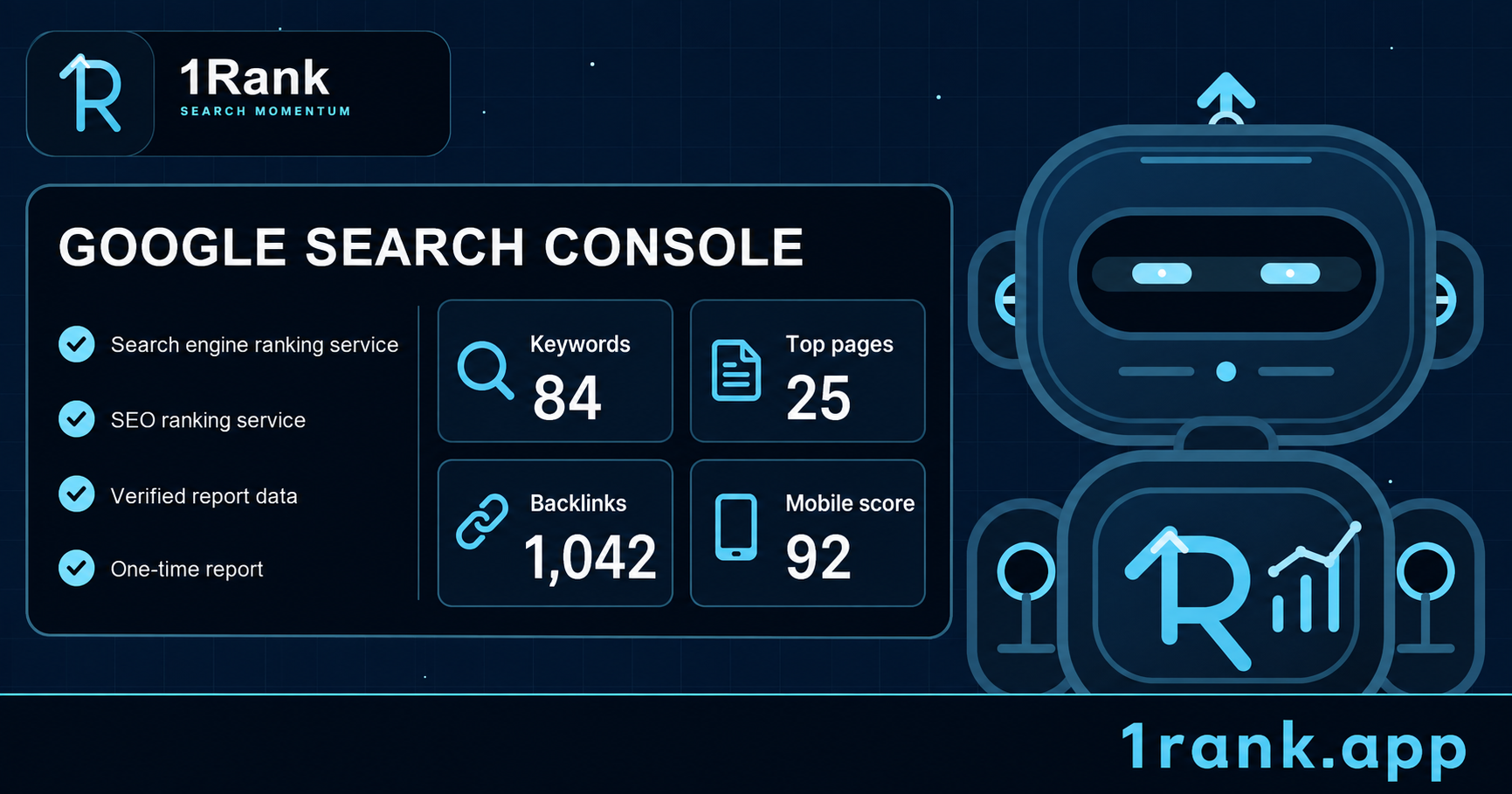
This article separates provider estimates, observed signals, and laboratory measurements. It does not promise rankings, traffic, leads, or revenue.
Start with one clear entitlement
A free website report should be useful without becoming an unbounded crawling promise. In 1Rank, a verified customer receives one saved baseline for the URL supplied during signup. Opening the dashboard reads that saved result; it does not create a new paid provider request.
That one-entitlement rule protects the customer experience and the operating budget. It also makes the report easier to explain: the snapshot is a dated starting point, while paid Robot services handle ongoing work and monitoring separately.
Validate the public destination before scheduling work
A reporting service should normalize the submitted URL, require a reachable public website, and reject private-network destinations before any provider request is created. It should also record crawl restrictions instead of trying to work around them.
This is both a safety boundary and a product boundary. A customer gets a report about the website they supplied, not an accidental scan of an internal host, a redirect chain with unclear ownership, or a URL substituted later in the workflow.
Bound every provider call
DataForSEO separates several useful data sources: Labs for ranking and market estimates, Backlinks for a live inbound-link index, and OnPage tasks for configurable crawling. Lighthouse runs a laboratory audit of a page rather than observing a real visitor session.
Those capabilities need limits. A one-time baseline can cap keyword and page lists, restrict recent-link proof, and set a maximum crawl-page count. Limits should be shown in the report so a reader knows what the snapshot covers and what it does not.
- Use a selected location and language for ranking details, then display that market beside the result.
- Save the provider task identifier before waiting for asynchronous crawl or Lighthouse work.
- Treat provider errors, restrictions, and delayed tasks as report states, not silent zeros.
- Reconcile an ambiguous paid request before retrying it, rather than submitting a duplicate task.
Persist useful sections as they finish
A single report usually completes in pieces. Ranking data may arrive immediately, while an OnPage crawl and Lighthouse task finish later. Saving each completed module lets the customer see the useful work that is ready without waiting for every provider response.
Laravel queues are a natural fit for this pattern because the signup and login request can finish quickly. The queue owns the provider calls, retries confirmed transient failures, and resumes work from saved task IDs instead of resubmitting it.
Keep the report understandable after it is complete
A report should show collection dates, source names, coverage limits, and why a module is unavailable. It should never expose provider credentials, raw response payloads, or more website data than the customer needs to act.
The final product is not a dashboard full of numbers. It is a dated, bounded baseline that helps a customer decide what to improve next, with continuing execution and monitoring available only when they choose a Robot plan.
SOURCE NOTES
Primary documentation
Checked Sep 5, 2026
-
DataForSEO Labs API overview
Documents live ranking, keyword, competitor, and domain analysis endpoints.
-
DataForSEO Backlinks API overview
Documents backlink totals, referring-domain data, and detailed backlink lists.
-
DataForSEO OnPage Task Post
Documents task creation and the required crawl-page limit.
-
DataForSEO Lighthouse Task Post
Documents task-based laboratory Lighthouse audits and result retrieval.