
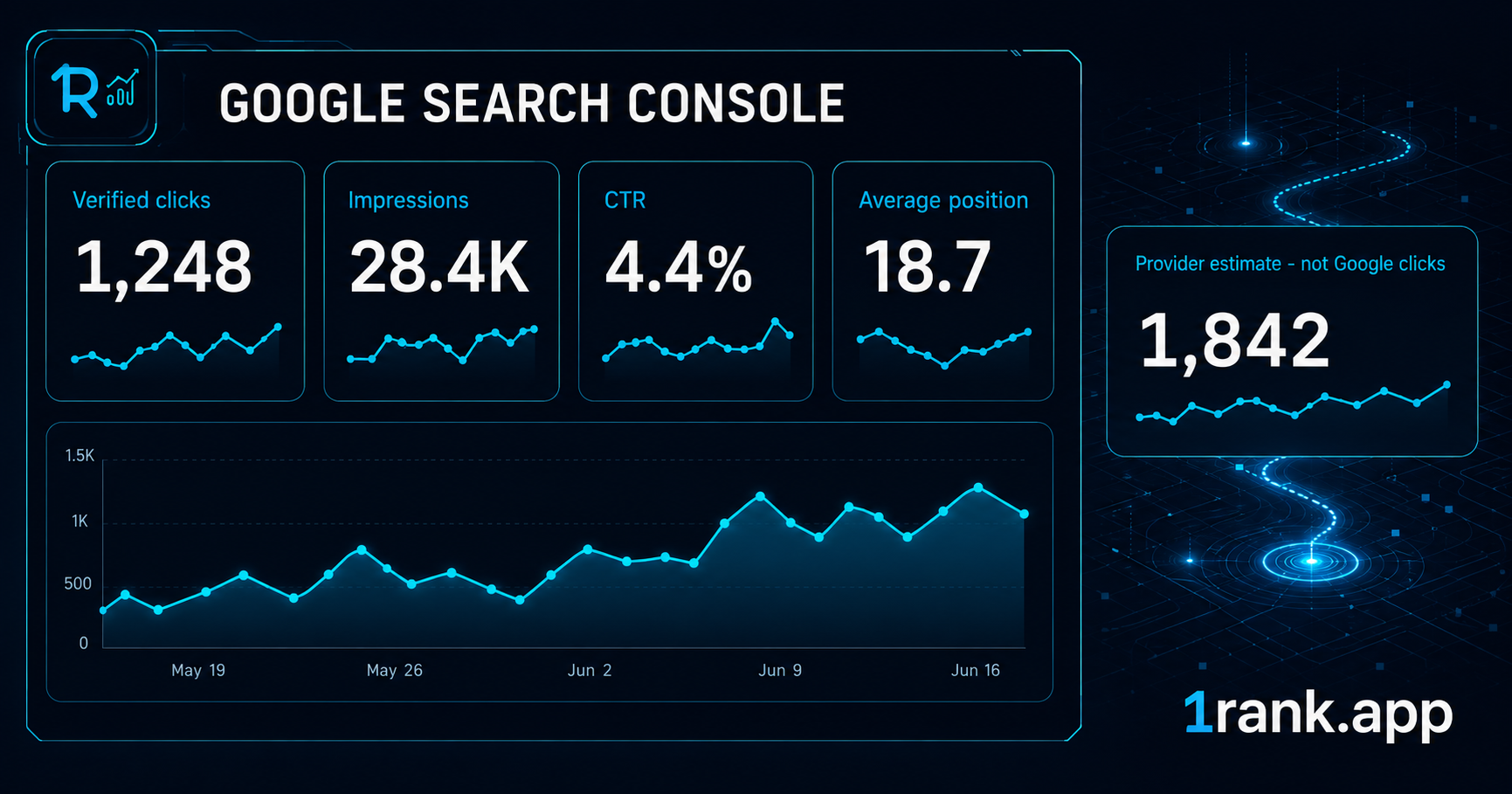
This article separates provider estimates, observed signals, and laboratory measurements. It does not promise rankings, traffic, leads, or revenue.
A click and an estimate answer different questions
Google Search Console defines a click as a user selecting a link to a site from Google Search results. That is observed activity for a verified property, within the report settings and date range chosen.
An estimated monthly traffic number is a modeled approximation. It can be useful for comparing opportunities, markets, pages, or competitors, but it is not an analytics event and it is not proof that a visitor arrived.
- Label Search Console clicks, impressions, CTR, and average position as Search Console data.
- Label modeled traffic as an estimate, name the provider, and state the selected market and collection date.
- Leave unavailable values unavailable. A missing source is not a zero, and a zero is not a reason to fill the gap with a model.
The label changes the decision a reader makes
A page can have a promising traffic estimate while receiving no verified clicks in a customer's Search Console property. The reverse can also happen when a page earns traffic through queries that are underrepresented in a third-party index or a different market.
Collapsing those measurements into one number creates a false sense of certainty. It can make a modeled opportunity look like a recorded outcome, or make a real reporting gap look like poor performance.
A clean measurement contract has four parts
Every number in a client report should be traceable without requiring the reader to know the underlying provider. The contract can be small, but it should be visible.
- Source: identify whether the figure came from Search Console, a backlink index, a crawl, or a ranking model.
- Scope: state the property, website, country, language, device, date range, or page limit that shaped the result.
- Collection time: show when the provider returned the result and whether it is a one-time snapshot or recurring monitoring.
- Meaning: use language that matches the measurement, including estimate, count, score, or unavailable.
Make comparisons useful without pretending they are identical
Search Console and a ranking-data provider can disagree for valid reasons. Google aggregates Search Console data according to the selected report dimension, while a ranking index uses its own database, market, language, and refresh timing.
A good workflow places the values beside one another only when the labels remain intact. For example, a report can show verified clicks from Search Console next to estimated monthly organic traffic from a selected market, then explain why the two are not interchangeable.
What this means for a one-time website report
A one-time report can give a new customer a useful baseline: indexed ranking keywords, modeled search opportunity, backlink totals, crawl findings, and a laboratory page-performance result. It should not promise a live analytics feed or present every provider field as equally precise.
At 1Rank, the report interface keeps estimated traffic explicitly labeled and reserves Google clicks for connected Search Console data. That distinction makes the report more honest and more actionable before ongoing Robot monitoring begins.
SOURCE NOTES
Primary documentation
Checked Sep 5, 2026
-
Google Search Console Help: Performance report overview
Defines clicks, impressions, CTR, average position, report dimensions, and aggregation.
-
DataForSEO Labs: Google overview
Describes ranking and traffic data from DataForSEO search datasets.
-
DataForSEO Labs: Domain Rank Overview
Documents modeled organic ranking distribution and estimated monthly traffic fields.